
Granted, I didn’t become vegan for health reasons, I can say with relative certainty that a plantbased diet with a preference for unprocessed foods is the healthiest diet available to humans. I call it a diet because it requires some knowledge and a fair amount of self-control to avoid (too often) giving in to the temptation of buying treats made up of combinations of refined starches and great amounts of sugar/salt and oils.
Furthermore, consistently eating plantbased requires reading labels; always and everywhere. Even seemingly unsuspected products can be “breastmilked”. For example, they sometimes add milk to fruit juices to avoid paying soda tax (NL), and I even once found milk listed among the ingredients on a jar of kidney beans. You wouldn’t believe it. You can just rinse that milk off, by the way, so that last point is more of a vegan annoyance than a plantbased one. A “plantbased” lifestyle is defined as eating/drinking predominantly plantbased foods, for whatever reason. Veganism is a lifestyle that avoids the use of animal products, anywhere, for ethical reasons. This is, of course, as far as practically feasible. For example, there’s a consensus among vegans (I think) that taking life-saving medications is simply the right thing to do.
After a post about a disgusting-looking cow’s milk product, aimed at toxic types, I received a question about why plantbased proteins are better than animal-based—in my opinion. This is a logical question, because from a young age, we’re brainwashed to believe that (cow’s) milk is good for everyone and that Strong Men need meat. Eggs are a basic breakfast staple, and if you have a cold, drink tea with honey vomited by bees.
However, it’s been scientifically proven that a diet of unprocessed plantbased foods is extremely healthy and that The Norm, the standard consumption pattern based on animal products, refined starches, and oils, is very unhealthy. On the NL news, we constantly hear about rising healthcare costs. The solution is sought in increasing deductibles, working more efficiently, and other things. However, you hear very little on the news about prevention as a way to reduce healthcare costs. I don’t even know if it’s been properly researched. I do know, however, that lifestyle diseases don’t just appear out of thin air. I’m in my mid-fifties; an age not everyone reaches. People in their forties or fifties regularly pass away, and then there’s widespread surprise because, “Yesterday he gave a performance, or I spoke to him at the barbecue.” I’m never really surprised, because I know there’s a lot going on beneath the surface in people; your arteries calcify, and cells regularly divide in an undesirable way, which can lead to cancer.
The word “cancer” brings me back to the question about proteins. Some time ago, the marketing people of the Netherlands and elsewhere, in their financial wisdom, decided that it’s a good thing to exploit the human fear of malnutrition; the protein craze was born. Oh yes, that’s called proteins in marketing jargon, because that sounds more scientific. It would have been possible to tempt everyone into consuming expensive legumes, but that wasn’t the case. Unfortunately, peanut butter (dutch expression; helaas pindakaas works better).
No, everyone—meaning people, not cows—should consume as much cow’s milk as possible.
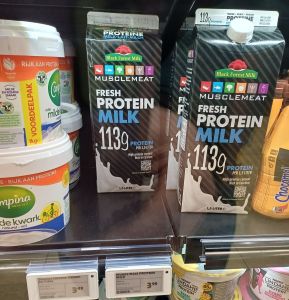
Now, milk isn’t very tasty, so we add sugar and flavorings to make it taste less unpleasant. And we increase the protein content, so we can promote it as sports nutrition and charge three times as much for a carton of milk. For people (men) who really aren’t trying to get old, there are also powders based on “whey.” It can always get crazier.
Back to basics: are we at risk of a protein deficiency? No, three times no. Everyone in the Netherlands who eats a sufficient and somewhat varied diet has no real risk of a protein deficiency. (They do, however, have a fiber deficiency! (After writing the dutch version of this article I heard that fibremaxxing is actually a new hype.)
Even potatoes contain protein. Protein is readily available in all shapes and sizes in plant-based foods. And of excellent quality, too. Even better than cow’s milk, because it’s not carcinogenic!
For someone who asked me about protein, I had searched NutritionFacts.org for some information about it. There was some useful information there about the cancer risk of animal protein. However, there’s so much more to say about it, and that’s also covered in NutritionFacts.org books like “How Not to Die”, but I understand that not everyone wants to read a book or finds the murder of baby pigs sad enough to stop eating them, so here’s this little health story.
Animal protein is carcinogenic, not just because it’s cooked at high temperatures. This is fairly well known.
Less well known is the effect on the kidneys. Kidneys are damaged by a diet rich in animal protein and low in fruits and vegetables.
This process is fully explained in “How not to Die?”.
Vegetable proteins are not taxing on the kidneys and do not cause kidney stones.
Animal proteins affect more organs, such as the heart, but also—men, please sit down first—the prostate. Prostate cancer causes urinary incontinence and erectile dysfunction. This disease affects a large number of people with male anatomy. A strong link between dairy and prostate cancer is evident in scientific research. That dairy “makes cancer cells go crazy” is not surprising, since cow’s milk is designed to help a calf quickly gain a LOT of weight. It is full of reproductive hormones that, when consumed by the “non-target population,” can cause significant damage.
Again, if you want to learn more about this, read the book or watch some free videos at NutritionFacts.org.
I hope it’s clear now that it’s not smart to eat animal protein to bulk up the muscles of your mortal body in a transparent attempt to increase your sexual attractiveness or to win some medals at a polluting sporting event.
There are truly so many reasons to eat plantbased or even become vegan (Yes, join the cult ;-). Health reasons are just one of them. Protein, on the other hand, is only a fraction of the whole health story. There’s really so much more to say about it. But that’s for another time. Or read the book.
Meanwhile, when I was young, I saw Bartje (a dutch fictional character, in a book about life a century ago) say on tv: “I don’t pray for brown beans”.
He hated the taste, not the nutritional value. Had he known how healthy beans are, well, no, he still wouldn’t have prayed for them. Bartje did realize that the health benefits of prayer haven’t been scientifically proven, while those of beans have been proven.
Enjoy your healthy meal! (Or your meal from hell 😉
 Tempting, but no.